Overview
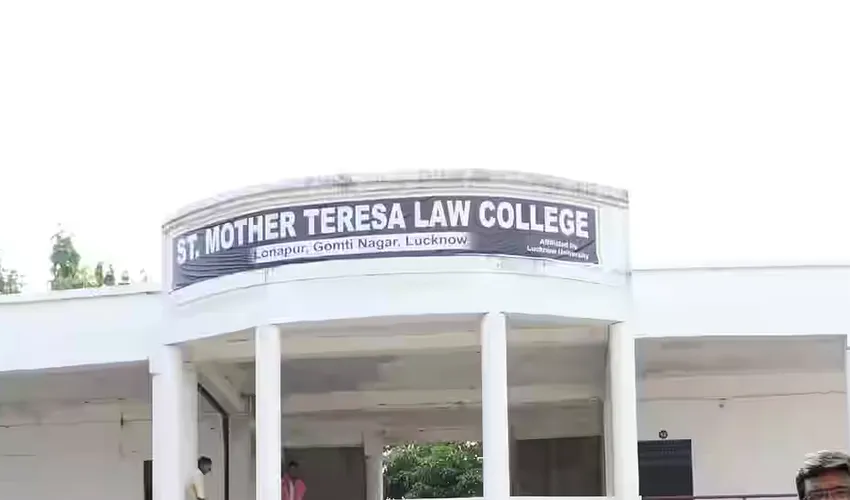
St. Mother Teresa Law Degree College is a BCI-approved affiliated law college associated with the University of Lucknow, located in the Lonapur–Gomti Nagar area of Lucknow, Uttar Pradesh. Established in 2009, the college is positioned as a focused legal-education institution rather than a multi-disciplinary university, offering classroom-based LLB and BA LLB programmes for students who want structured preparation for advocacy, judiciary services, corporate legal roles and higher legal studies.
The college’s academic identity centres on practical legal learning. Its highlighted strengths include moot court training, legal research orientation, library and reading-room support, computer lab and Wi-Fi access, seminar-style learning, and exposure to contemporary fields such as intellectual property, cyber crime, commercial arbitration, immigration law and family laws. For aspirants comparing options in Lucknow, the key value proposition is affordable legal education with an emphasis on courtroom-style argumentation, procedure familiarity and regular full-time campus study.
St. Mother Teresa Law Degree College primarily runs two law pathways: a 3-year LLB for graduates and a 5-year integrated BA LLB for students entering after Class 12. Public listings indicate approved/commonly advertised intake of about 180 seats for LLB and 120 seats for BA LLB, though students should confirm the current sanctioned intake and BCI/University approval status for the exact admission year before applying. Admissions are generally merit and eligibility based, aligned with Bar Council of India and University of Lucknow norms.
The campus is compact, co-educational and supported by facilities commonly listed for the group, including hostel options, library, sports, IT infrastructure, cafeteria, auditorium, transport and medical support. The main campus is in Lucknow, with admission communication also associated with the group’s Lucknow offices. For students seeking a lower-cost law college in Uttar Pradesh with a clear LLB/BA LLB focus, moot court practice and affiliation to a recognised public university, St. Mother Teresa Law Degree College is a practical option—provided applicants verify the latest fee structure, approval cycle, seat matrix and degree recognition directly during admission.
Rankings
- Institute type: Private affiliated law college; not a standalone university.
- Recognition: Promoted as BCI-approved and affiliated/associate to the University of Lucknow.
- Affiliation value: Degrees are positioned under University of Lucknow norms; students should verify current BCI approval and programme-specific recognition for their admission batch.
- Ranking status: No widely verified standalone NIRF, NAAC or major national law-school rank was found for the college itself; claims should be checked against official current-cycle records.
- Accreditation caution: Any NAAC grade associated with the parent university should not be treated as the college’s own accreditation unless separately notified.
- Known strengths: Moot court participation, legal-research environment, affordable fee positioning and focused LLB/BA LLB offerings.
Courses & Fees
| Courses | Total Tuition Fees | Eligibility |
|---|---|---|
| LLB, 3 years full-time | Approx. ₹0.65–1.01 lakh total | Graduation in any discipline; usually 45% for General, 40% for SC/ST as per BCI/University norms |
| BA LLB, 5 years integrated full-time | Approx. ₹2.29–2.51 lakh total | 10+2 from a recognised board; commonly 45% General, 42% OBC, 40% SC/ST |
Placements
- Placement transparency: A verified, audited law-placement report with official recruiter names, median salary and year-wise offers is not consistently published.
- Typical career routes: Litigation practice, chamber apprenticeship, judiciary/PCS-J preparation, legal associate roles, corporate legal cells, compliance support, NGOs, PSUs via exams and higher studies.
- Reported figures: Aggregator/review claims mention packages roughly in the ₹4.5–6 LPA range, but these are not uniform and should be treated as indicative rather than official.
- Employability support: Moot court training, courtroom procedure exposure, library/research facilities and legal-writing practice are the main cited career-readiness features.
- Practical outlook: Like many affiliated law colleges, outcomes depend heavily on individual internships, Bar Council enrolment process, AIBE preparation, local court networking and post-LLB specialization.
Location
Listing Owner

Related Listings